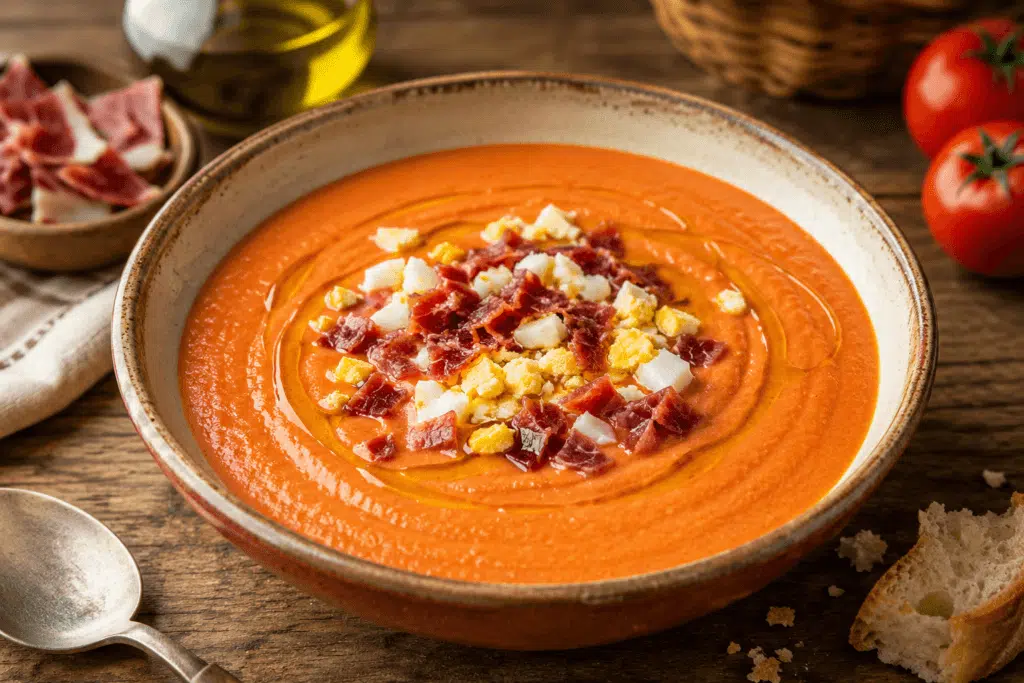
Salmorejo is one of the great cold dishes of southern Spain: thick, creamy, intensely tomato-flavored and surprisingly rich despite being made from only a handful of simple ingredients.
Originally associated with Córdoba, this Andalusian classic combines ripe tomatoes, day-old bread, garlic and extra virgin olive oil until everything emulsifies into a smooth, velvety soup.
Unlike gazpacho, salmorejo is deliberately thick. It is usually eaten with a spoon rather than drunk from a glass, and the traditional finish of chopped hard-boiled egg and serrano ham makes it feel substantial enough for a light lunch or starter.
The secret is not adding more ingredients. It is using sweet ripe tomatoes, enough bread to give the soup body and adding the olive oil slowly so it becomes beautifully creamy.
If you enjoy traditional Spanish dishes served cold, you may also like our Authentic Spanish Gazpacho or this simple Pan con Tomate.
What to expect: A thick, smooth tomato and bread soup with a balanced garlic flavor.
Jump to ingredients and method ↓
🇪🇸 What Is Salmorejo?
Salmorejo is a traditional cold tomato dish associated with Córdoba in Andalusia.
Its basic ingredients are remarkably simple: tomatoes, bread, garlic, olive oil and salt.
It is traditionally served cold with chopped hard-boiled egg and serrano ham on top.
The bread and olive oil are what give it its characteristic thick, creamy texture.
⏱️ Time and Servings
| Stage | Time |
|---|---|
| Preparation | 15 minutes |
| Cooking (assuming ready-cooked eggs) | 0 minutes |
| Bread soaking time | 10 minutes |
| Chilling time | 1 hour |
| Total time | About 1 hour 25 minutes |
| Servings | 4 people |
If you need help converting grams, milliliters or tablespoons, see our Cooking Measurement Conversion Chart.
🍲 Equipment You Will Need
- Blender or food processor
- Fine sieve, if desired
- Knife and chopping board
- Covered bowl or jug for chilling
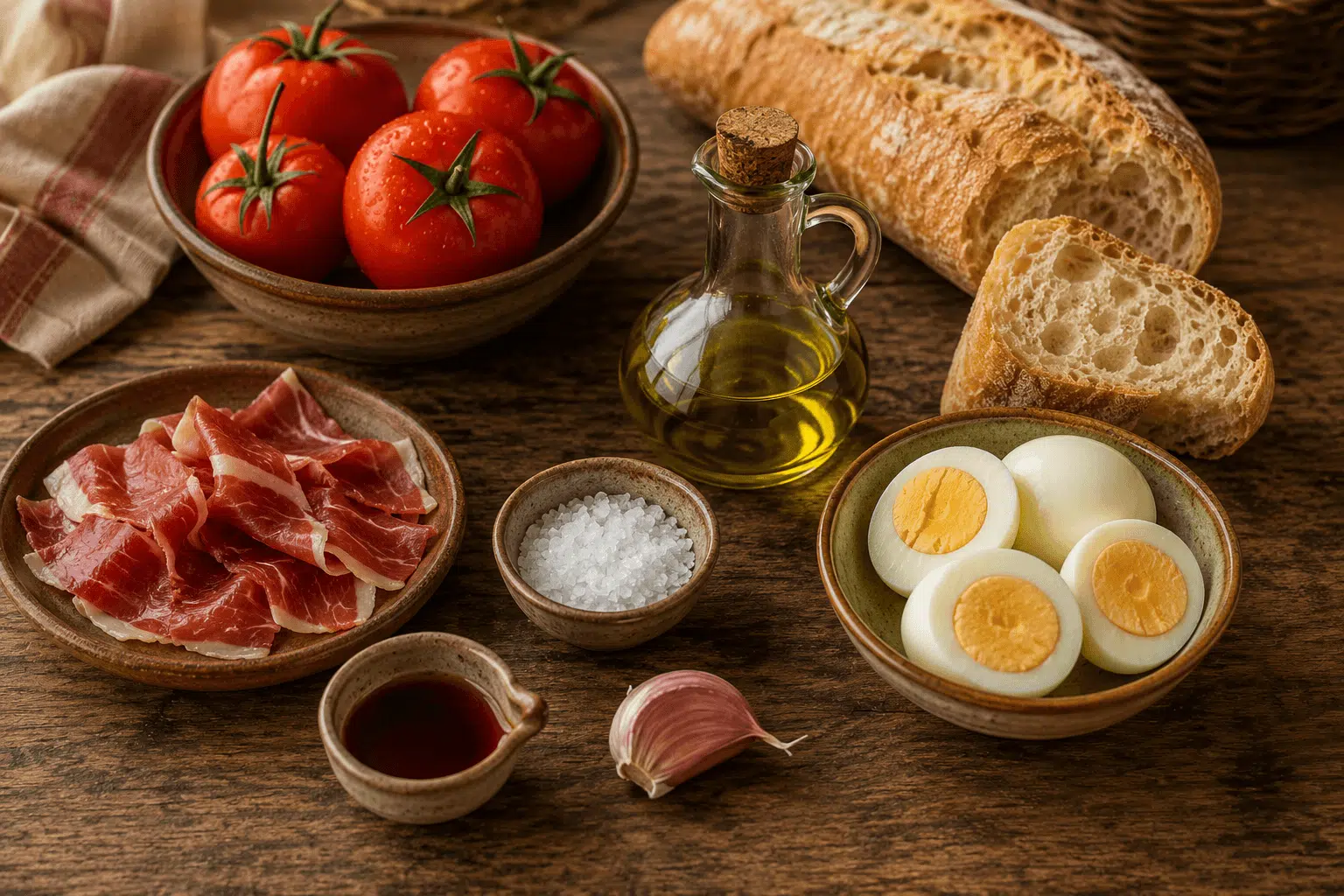
🛒 Ingredients for 4 servings
- 1 kg ripe tomatoes
- 180 g day-old rustic white bread
- 1 small garlic clove
- 100 ml (about ⅓ US cup plus 1 tablespoon) extra virgin olive oil
- Salt, to taste
- 1 tablespoon sherry vinegar, optional
- 2 hard-boiled eggs, chopped, for serving
- 50 g serrano ham, finely chopped, for serving
Ingredient tip: this is not the recipe for pale supermarket tomatoes. Use the ripest, sweetest tomatoes you can find because they provide almost all of the fresh flavor.
👨🍳 How to Make Salmorejo
1️⃣ Prepare the tomatoes
Wash the tomatoes and cut them into rough pieces.
There is no need to peel them if you have a powerful blender or plan to strain the mixture later.
Place them in the blender and blend until completely liquid.
2️⃣ Strain the tomato if you want an extra-smooth result
For a particularly silky salmorejo, pass the blended tomato through a fine sieve.
This removes pieces of skin and seeds without losing the tomato juice.
It is optional, but the final texture is noticeably smoother.
3️⃣ Soak the bread in the tomato
Tear the day-old bread into pieces and add it directly to the blended tomato.
Leave it for around 10 minutes.
The bread will absorb the tomato juice and soften completely.
Do not add water. Salmorejo should get most of its liquid from the tomatoes themselves.
4️⃣ Add garlic and salt
Add the garlic and a good pinch of salt.
Blend again until the bread disappears completely into the tomato.
Start with one small garlic clove.
Raw garlic becomes much stronger once blended, so it is easier to add a little more later than to fix an overpowering soup.
5️⃣ Emulsify with the olive oil
With the blender running, slowly pour in the extra virgin olive oil.
Do not add it all at once.
As the oil emulsifies with the tomato and bread, the color should become slightly lighter and the texture noticeably creamier.
This is the step that turns blended tomatoes and bread into proper salmorejo.
6️⃣ Taste and adjust
Taste before adding anything else.
Adjust the salt.
If you like a touch more acidity, add a small amount of sherry vinegar.
Some home-style versions use vinegar and others do not, so treat it as an adjustment rather than something that must dominate the dish.
7️⃣ Check the consistency
The finished mixture should be much thicker than gazpacho.
When you lift a spoonful, it should fall back slowly rather than run like juice.
If it seems too thick, add a very small amount of tomato juice rather than automatically adding water.
8️⃣ Chill thoroughly
Transfer the salmorejo to a covered container and refrigerate for at least 1 hour.
Two or three hours is even better.
The soup should be properly cold when served.
9️⃣ Add the traditional toppings
Pour into shallow bowls.
Top each serving with chopped hard-boiled egg and small pieces of serrano ham.
Finish with a thin drizzle of extra virgin olive oil.
👀 How to Know Your Salmorejo Is Right
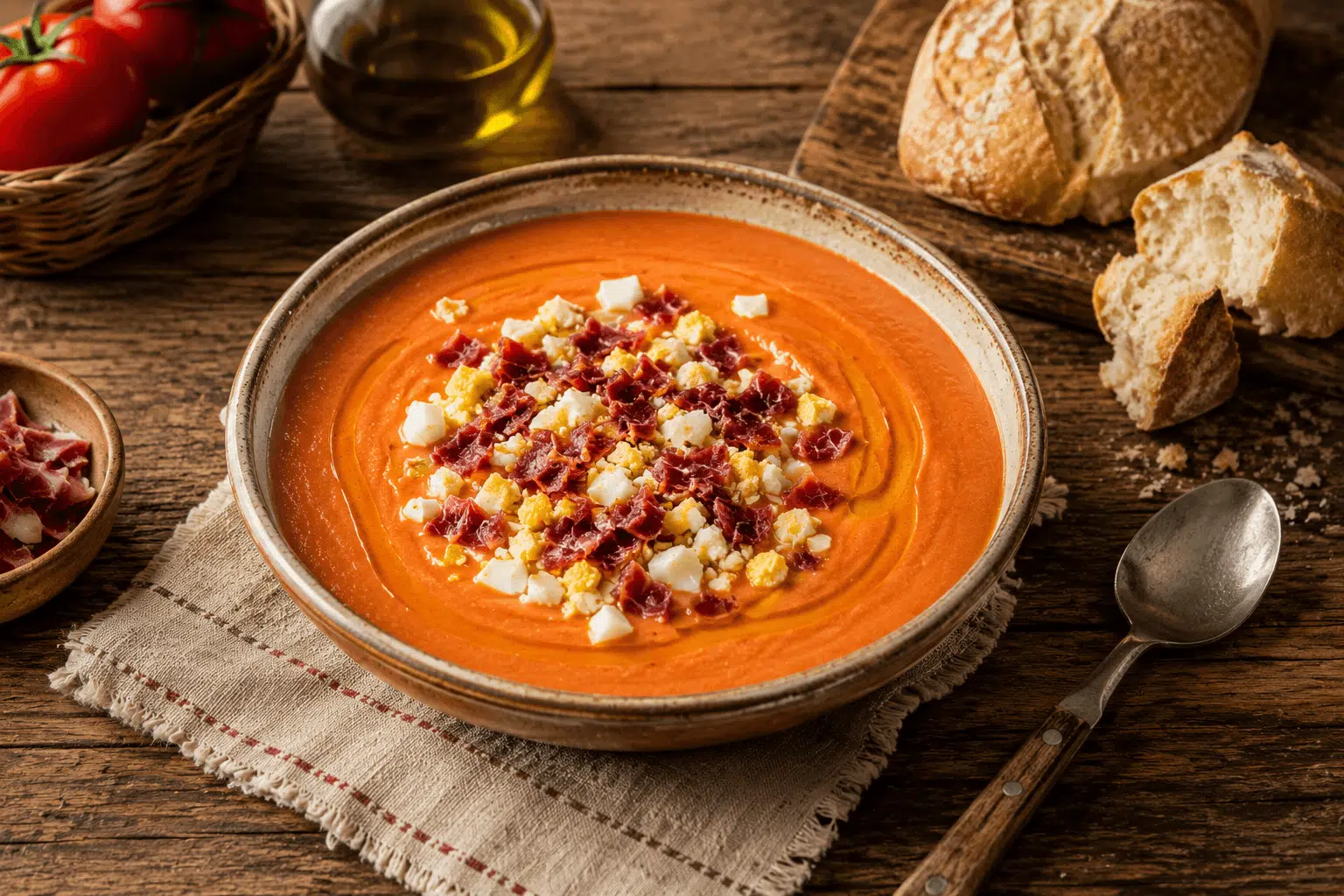
A well-made salmorejo should have:
- A thick consistency that holds nicely on a spoon.
- A completely smooth texture without obvious bread pieces.
- A pale orange-red color after the olive oil emulsifies.
- A fresh tomato flavor rather than a strong garlic taste.
- A creamy mouthfeel even though there is no cream or dairy.
If it looks watery and pours like juice, it is closer in texture to gazpacho than salmorejo.
🥣 Salmorejo vs Gazpacho: What Is the Difference?
They are both famous cold Andalusian dishes, but they are not the same recipe.
Salmorejo is thicker and richer. Bread and olive oil play a major role, and it normally contains fewer vegetables.
Gazpacho is lighter and more fluid and commonly includes cucumber and pepper along with tomato.
You can compare the two by trying our Spanish Gazpacho Recipe.
✨ Tips for Better Salmorejo
- Choose very ripe tomatoes: this has more impact than almost anything else.
- Use day-old rustic bread: it absorbs tomato juice and gives the soup body.
- Add the olive oil slowly: proper emulsification creates the silky texture.
- Do not add too much garlic: it should support the tomato, not overpower it.
- Chill before serving: the flavors become cleaner and more balanced when cold.
- Use extra virgin olive oil: its flavor remains noticeable in such a simple recipe.
🥚 Traditional Salmorejo Toppings
The classic finish is:
- Chopped hard-boiled egg
- Finely chopped serrano ham
- A drizzle of extra virgin olive oil
You do not need much.
The toppings should add contrast without covering the tomato flavor underneath.
🔄 Ingredient Notes and Swaps
Omit the ham topping for a vegetarian version. Choose bread with a soft crumb; the amount needed depends on how juicy the tomatoes are.
Can You Make Vegetarian Salmorejo?
Yes.
Simply leave out the serrano ham and serve it with chopped hard-boiled egg and olive oil.
For a fully vegan version, omit both egg and ham and garnish with chopped vegetables, toasted almonds or a little extra olive oil.
⚠️ Common Problems and Easy Fixes
The salmorejo is too watery
Do not automatically add water when blending.
Ripe tomatoes usually provide enough liquid.
Use enough bread and allow it time to soak before blending.
It tastes too strongly of garlic
The garlic clove was probably too large.
Raw garlic is powerful in cold soups, so start small.
The texture is grainy
Blend for longer.
A powerful blender and properly softened bread make a big difference.
You can also strain the tomato before adding the bread.
It does not taste creamy
The olive oil may have been added too quickly.
Pour it in slowly while blending so it emulsifies properly.
It tastes flat
First adjust the salt.
If it still needs brightness, add a little sherry vinegar.
🍽️ What to Serve With It
Salmorejo works particularly well as a first course before a larger Spanish meal.
You can serve it alongside:
- Pan con Tomate
- Gambas al Ajillo
- Spanish Omelette
- Olives and crusty bread
For dessert, something simple like Arroz con Leche works beautifully.
❄️ Storage and Serving
Store salmorejo in an airtight container in the refrigerator.
It will keep well for around 2 days.
Do not add the egg and ham until serving.
Stir or blend briefly before eating again because the mixture can separate slightly while resting.
🥄 Approximate Nutrition
| Nutritional value | Approximate amount per serving |
|---|---|
| Calories | 290 kcal |
| Protein | 8 g |
| Fat | 18 g |
| Carbohydrates | 22 g |
| Fiber | 3 g |
| Sodium | 340 mg |
Nutritional values are approximate and depend on the bread, olive oil and amount of toppings used.
❓ Frequently Asked Questions
What is salmorejo made of?
Traditional salmorejo is based on ripe tomatoes, bread, garlic, olive oil and salt.
It is commonly topped with hard-boiled egg and serrano ham.
Is salmorejo served hot or cold?
Cold.
It should be thoroughly chilled before serving.
Why is salmorejo so thick?
Bread gives the soup body while olive oil emulsifies with the tomatoes to create a dense, creamy texture.
Do you need to peel tomatoes for salmorejo?
No.
A powerful blender can process the skins well, and you can strain the tomato mixture if you want an especially smooth result.
Can salmorejo be made the day before?
Yes.
It is an excellent make-ahead dish and usually tastes even better after several hours in the refrigerator.
Can salmorejo be made without bread?
You can make a tomato soup without bread, but bread is an important part of the traditional texture of salmorejo.
Is salmorejo the same as gazpacho?
No.
Salmorejo is considerably thicker and creamier, while gazpacho is usually lighter and contains more fresh vegetables.
Salmorejo is a perfect example of how Spanish home cooking can turn a few ordinary ingredients into something memorable.
There is no need for cream, complicated spices or a long cooking process.
Use ripe tomatoes, soften the bread properly and slowly emulsify in good olive oil.
Serve it cold with egg and serrano ham and you have one of the most distinctive dishes of an Andalusian summer.
Recipe prepared for Spanish Grandma Recipes.
Discover more from Spanish Grandma Recipes
Subscribe to get the latest posts sent to your email.