
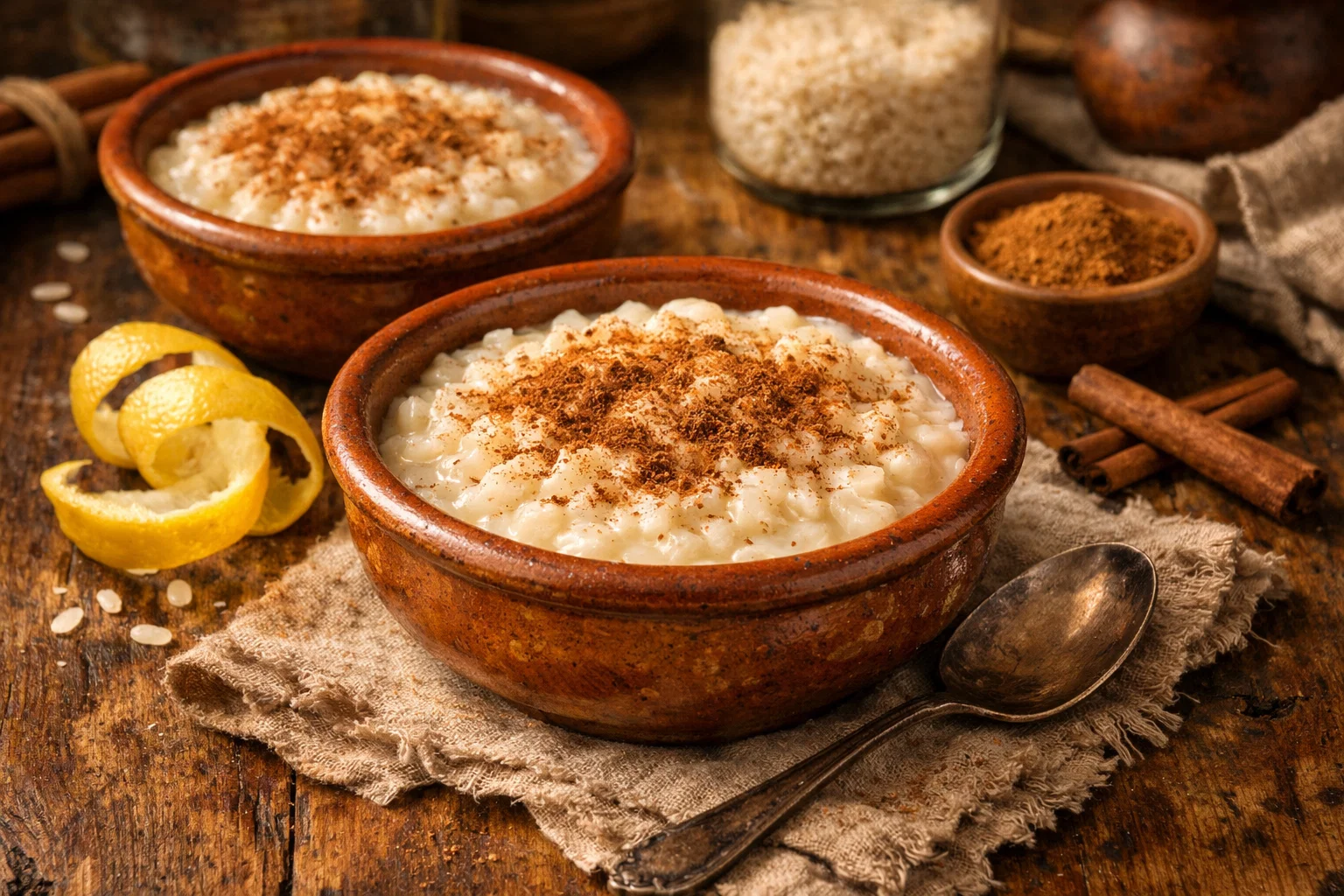

🍚 Arroz con Leche Recipe: Creamy Traditional Spanish Rice Pudding
Few desserts feel as comforting as a bowl of arroz con leche. This traditional Spanish rice pudding is made with simple ingredients — milk, rice, sugar, cinnamon and lemon peel — but the slow cooking turns them into something wonderfully creamy and fragrant.
In Spain, arroz con leche is one of those desserts that many people associate with family meals and recipes made at home for generations. The texture should be creamy rather than dry, with tender rice surrounded by thickened milk scented with cinnamon and citrus.
The most important part is patience. There is no need to rush it: gentle heat and regular stirring allow the rice to release its starch naturally and give the pudding its characteristic silky texture.
If you enjoy traditional Spanish desserts, you may also like these Spanish porras, especially if you are building a collection of classic homemade Spanish sweets.
⏱️ Time Table
| Stage | Time |
|---|---|
| Preparation time | 10 minutes |
| Cooking time | 40–45 minutes |
| Cooling time | 1 hour |
| Total time | About 1 hour 55 minutes |
| Servings | 6 people |
🛒 Ingredients for Arroz con Leche
- 1 litre whole milk
- 150 g short-grain rice
- 100 g sugar
- 1 cinnamon stick
- 1 wide strip of lemon peel
- 1 strip of orange peel, optional
- 20 g butter, optional
- Ground cinnamon, for serving
- A small pinch of salt

Whole milk gives the best result here because it creates a richer and creamier pudding. Short-grain rice is also important, as it releases more starch during cooking than most long-grain varieties.
When peeling the lemon, try to take mostly the yellow part of the skin. Too much of the white pith underneath can introduce bitterness.
👨🍳 How to Make Traditional Spanish Arroz con Leche
1️⃣ Infuse the milk
Pour the milk into a wide saucepan and add the cinnamon stick, lemon peel, orange peel if using and a small pinch of salt.
Warm it over medium-low heat until it is steaming and very hot, but do not let it boil aggressively.
Leave it for a few minutes so the cinnamon and citrus begin to perfume the milk.
2️⃣ Add the rice and lower the heat
Add the rice and stir well.
Lower the heat and cook very gently for around 30 to 35 minutes, stirring regularly and scraping the bottom of the pan with a wooden spoon.
The milk should barely simmer.
This slow cooking is what allows the rice to soften while gradually releasing starch into the milk.
3️⃣ Watch the texture
As the rice cooks, the mixture will slowly become thicker.
Do not wait until it looks like a completely set pudding in the saucepan. Arroz con leche continues to thicken considerably as it cools.
At this stage, the rice should be tender but still surrounded by plenty of creamy milk.
4️⃣ Add the sugar near the end

Once the rice is tender, add the sugar.
Stir well and continue cooking over low heat for another 5 to 10 minutes.
I prefer adding the sugar near the end because the rice has already had time to soften properly before the sweetness is introduced.
5️⃣ Remove the cinnamon and citrus peel
Take out the cinnamon stick and the lemon and orange peel.
If you want a slightly richer finish, stir in the butter while the pudding is still hot.
This is completely optional; traditional arroz con leche is already creamy without it.
6️⃣ Check the final consistency
The pudding should look creamy and slightly loose when you remove it from the heat.
If it seems very thick already, stir in a small splash of warm milk.
If it is too thin, cook it for another few minutes while stirring.
7️⃣ Divide into bowls
Spoon the arroz con leche into individual bowls or ramekins.
Let it cool for a short time at room temperature, then refrigerate it for at least one hour if you prefer it chilled.
8️⃣ Finish with cinnamon
Sprinkle ground cinnamon over the top just before serving.
Some regional versions are finished differently, but a light dusting of cinnamon is probably the simplest and most recognizable presentation.

👀 How to Know When Arroz con Leche Is Ready
The easiest mistake is cooking it until it looks perfectly thick in the saucepan.
Instead, look for these signs:
- The rice is completely tender with no hard center.
- The milk looks creamy and lightly coats the spoon.
- The mixture is still slightly loose when hot.
- The rice remains surrounded by creamy liquid rather than looking dry.
Remember that it will become noticeably thicker once cold.
⚠️ Common Problems and How to Fix Them
My arroz con leche is too thick
This usually happens because it was reduced too much or because the rice absorbed more milk while cooling.
Stir in a little cold or warm milk until it reaches the consistency you like.
The rice is still hard
Keep cooking it slowly and add a little extra warm milk if necessary.
Do not increase the heat too much, because the milk can stick or burn on the bottom.
The milk has caught on the bottom
The heat was probably too high or the mixture was not stirred often enough.
Use low heat and a heavy-bottomed saucepan if possible.
It tastes slightly bitter
Too much white pith may have been left on the lemon or orange peel.
Use only a thin strip of the colored outer peel.
✨ Tips for Extra Creamy Spanish Rice Pudding
- Use whole milk: it gives the richest texture.
- Choose short-grain rice: it releases starch naturally as it cooks.
- Keep the heat low: slow cooking is much better than boiling.
- Stir regularly: especially during the final 15 minutes.
- Add the sugar near the end: after the rice is already tender.
- Do not overcook it: the pudding thickens considerably as it cools.
- Adjust with milk before serving: especially if it has been refrigerated overnight.
🧊 Storing Arroz con Leche
Store leftover arroz con leche covered in the refrigerator for up to 3 days.
It will become thicker as it sits, so before serving you can stir in a small splash of milk to bring back its creamy texture.
You can serve it directly from the refrigerator, let it sit at room temperature for a few minutes, or warm it gently in a saucepan.
🥄 Nutritional Information
| Nutritional value | Approximate amount per serving |
|---|---|
| Calories | 255 kcal |
| Protein | 6 g |
| Fat | 7 g |
| Carbohydrates | 41 g |
| Sugar | 18 g |
| Fiber | 1 g |
Nutritional values are approximate and may vary depending on the milk, sugar and optional butter used.
❓ FAQ About Arroz con Leche
What is arroz con leche?
Arroz con leche is a traditional Spanish rice pudding made by slowly cooking rice in milk with sugar, cinnamon and citrus peel until creamy.
What type of rice is best for arroz con leche?
Short-grain rice works especially well because it releases starch while cooking and creates a naturally creamy texture.
Should you rinse the rice first?
For this dessert, I prefer not to rinse it heavily because the surface starch helps thicken the milk.
Can I make arroz con leche ahead of time?
Yes. It is an excellent make-ahead dessert and can be prepared the day before.
Just remember that it thickens in the refrigerator, so you may want to loosen it with a little milk before serving.
Why is my arroz con leche too thick after chilling?
The rice continues absorbing liquid as it rests.
Simply stir in a splash of milk until the pudding becomes creamy again.
Can arroz con leche be served warm?
Yes. It is delicious both warm and chilled.
Warm arroz con leche tends to be looser and particularly comforting during colder weather.
Can I make it without butter?
Absolutely.
Butter is optional and is not necessary for a creamy result if you use whole milk and cook the rice slowly.
🍮 A Simple Spanish Dessert That Never Goes Out of Style
Arroz con leche is a good example of how traditional Spanish cooking can turn a handful of everyday ingredients into something memorable.
The key is not adding anything complicated. It is giving the rice enough time to cook slowly in the aromatic milk until everything becomes creamy and soft.
Finish it with cinnamon and serve it warm or chilled. Either way, it is one of those homemade desserts that tastes even better after the first spoonful.
Discover more from Spanish Grandma Recipes
Subscribe to get the latest posts sent to your email.