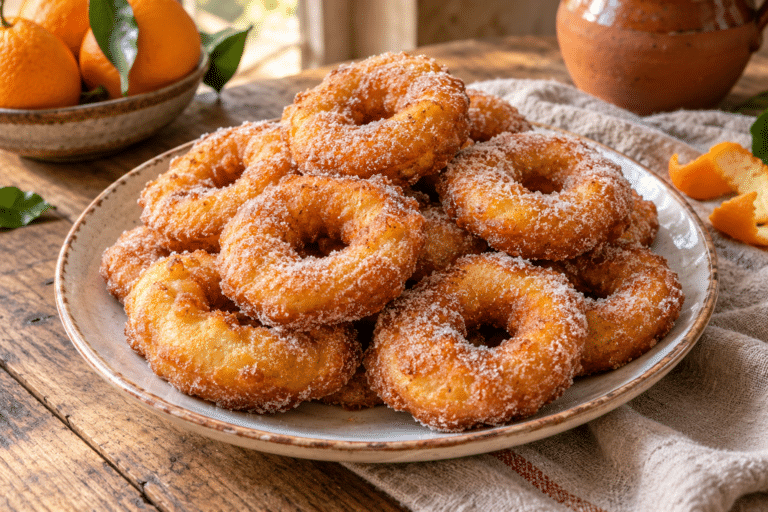
Buñuelos de viento are small fried dough puffs with a light, airy center. The dough starts in a saucepan, then eggs are beaten in before little spoonfuls are fried and rolled in sugar. Lemon zest and a touch of cinnamon give this version a gentle aroma.
They are especially welcome as an autumn sweet, but the technique is useful all year. The important details are the consistency of the dough and an oil temperature that gives the center time to cook before the outside becomes dark.
What to expect: About 20 small unfilled puffs, enough for five servings of four. They will be irregular rather than perfectly round, with an airy interior and a thin golden shell.
Jump to ingredients and method ↓
🥄 A Cooked Dough That Puffs in Oil
This style uses a cooked flour paste enriched with eggs, similar in principle to choux pastry. Steam helps the little portions expand. There is no yeast and no rising period, so the consistency must be right before frying starts.
Unlike churros, these are portioned with spoons and contain eggs. They also differ from leche frita, which begins as a chilled milk mixture cut into pieces.
⏱️ Time and Servings
| Stage | Time |
|---|---|
| Preparation | 20 minutes |
| Cooking | 25 minutes |
| Dough cooling | 10 minutes |
| Total time | 55 minutes |
| Servings | 5 |
🍲 Equipment You Will Need
- A small saucepan and sturdy wooden spoon
- A mixing bowl and two teaspoons
- A deep heavy saucepan for frying
- A frying thermometer, slotted spoon and wire rack
🛒 Ingredients for 5 Servings
- 125 ml water
- 50 g unsalted butter, cut into small cubes
- 75 g plain all-purpose flour
- 15 g granulated sugar for the dough
- A small pinch of fine salt
- Finely grated zest of ½ lemon
- 2 large eggs, beaten separately; you may not need every drop of the second
- About 750 ml sunflower oil, or enough for 4 cm depth in a suitable pan
- 40 g granulated sugar for coating
- ½ teaspoon ground cinnamon, optional, for coating
Weigh the flour: small differences matter in this dough. A kitchen scale is more reliable than packing flour into a cup. Our measurement guide helps with other quantities.
Eggs: the amount absorbed depends on egg size and how much moisture leaves the dough in the saucepan. Add the second egg gradually and stop when the mixture is glossy and slowly drops from the spoon.
Pan safety: leave plenty of space above the oil and never fill a frying pan more than one third full. The puffs expand as they cook.

👨🍳 How to Make Buñuelos de Viento
1️⃣ Heat the water and butter
Put the water, butter, 15 g sugar, salt and lemon zest in the small saucepan. Heat gently until the butter melts, then bring to a brief boil. Have the weighed flour ready so the water does not boil away while you measure.
2️⃣ Cook the flour paste
Take the pan off the heat and add all the flour at once. Stir firmly until no dry flour remains. Return to low heat and stir for 1 to 2 minutes, until the dough pulls together and a light film forms on the base. Transfer to a mixing bowl.
3️⃣ Cool, then beat in the eggs
Let the paste cool for about 10 minutes until warm rather than hot. Beat in the first egg thoroughly; the dough will look separated before it becomes smooth. Add the second egg a little at a time. Stop when the dough is glossy and forms a thick, slow-falling ribbon from the spoon, not a runny batter.
4️⃣ Heat the frying oil
Heat the oil to about 170°C / 340°F. Mix the coating sugar and optional cinnamon in a shallow bowl. Set a rack over a tray for draining. Use two teaspoons to form small portions of dough, roughly 2 teaspoons each.
5️⃣ Fry a small test batch
Carefully slide 3 or 4 portions into the oil, keeping the spoons close to the surface without touching it. Fry for about 4 to 5 minutes, turning gently as needed, until puffed and evenly golden. Keep the oil around 170 to 175°C / 340 to 350°F. Cut one open: the inside should be airy and cooked, without wet paste.
6️⃣ Adjust and finish the batch
If the test puff browned while the center stayed wet, make smaller portions or lower the heat slightly. Continue in small batches, letting the oil recover between them. Lift onto the rack and drain briefly. Skim out loose bits of dough that could burn.
7️⃣ Coat while warm and serve
Roll the warm, drained puffs lightly in cinnamon sugar and transfer to a serving dish. Let them cool just enough to eat comfortably. Serve soon after frying, when the outside is at its best and the centers are still light.

🥚 Knowing When to Stop Adding Egg
The dough should be soft enough to drop from a spoon but firm enough to hold a rounded mound for a moment. If it streams off like pancake batter, too much egg has been added. Adding raw flour afterward creates lumps and does not reliably restore the cooked paste.
Beat thoroughly between additions. Dough that looks split just after egg goes in often becomes smooth with more mixing. Judge the final consistency only after the egg already added has been fully incorporated.
🔄 Ingredient Swaps and Variations
- Orange zest: use the same quantity instead of lemon for a different citrus aroma.
- Plain sugar: omit cinnamon if you want the lemon flavor to stand out.
- Filled puffs: cool completely before filling with chilled pastry cream or whipped cream. Filled versions need refrigeration and are not included in this recipe’s timing or nutrition.
- No citrus: omit the zest; the dough still works without it.
⚠️ Common Problems and Easy Fixes
- Raw center: portions were too large or the oil too hot. Test one puff before committing the whole batch.
- Greasy puffs: the oil cooled too much. Fry fewer at a time and let the temperature recover.
- Flat, spreading dough: too much egg made the mixture loose. Add egg gradually next time and stop at the texture cue.
- Dense puffs: the dough may be too stiff or insufficiently mixed. Check the slow-ribbon consistency before frying.
🍽️ What to Serve With It
Serve unfilled with coffee, tea or a small cup of hot chocolate. A light sugar coating is enough; heavy sauces can hide the delicate shell.
For another Spanish sweet with a soft center and crisp exterior, see torrijas. Both are best enjoyed shortly after their final frying stage.
❄️ Storage and Reheating
Unfilled buñuelos are best on the day they are made. Once completely cool, keep covered and refrigerated if storing overnight, and use within 2 days. Rewarm briefly in an oven until heated through; the texture will be less delicate than fresh.
Do not store warm puffs in a sealed container, where steam softens them. If adding a dairy or egg-based filling, refrigerate promptly and follow the filling’s storage instructions.
🥄 Approximate Nutrition
| Per serving: about 4 small buñuelos | Estimate |
|---|---|
| Calories | 270 kcal |
| Protein | 4 g |
| Carbohydrates | 23 g |
| Fat | 18 g |
| Fiber | 1 g |
Approximate values for four small puffs, assuming about 40 g frying oil retained across the batch and all coating sugar used. Actual oil absorption and yield vary.
❓ Frequently Asked Questions
Do they need yeast or baking powder?
Not in this version. The cooked dough and eggs expand through steam during frying.
Why are they called de viento?
The name refers to their light, airy character. The inside should have space and delicate walls rather than a dense cake-like crumb.
Can I bake this dough instead?
Baking produces a different choux-style puff and needs different timing. The instructions here are designed for frying.
Can I make the dough in advance?
For the most predictable texture, prepare and fry it in the same session. The dough is quick once the ingredients are measured.
Must they turn by themselves?
Some puffs roll as they expand, but not all do. Turn them gently with a slotted spoon so every side colors evenly.
Recipe written for Spanish Grandma Recipes. By José María. The images are original AI-generated illustrations of the dish and ingredients.
Discover more from Spanish Grandma Recipes
Subscribe to get the latest posts sent to your email.