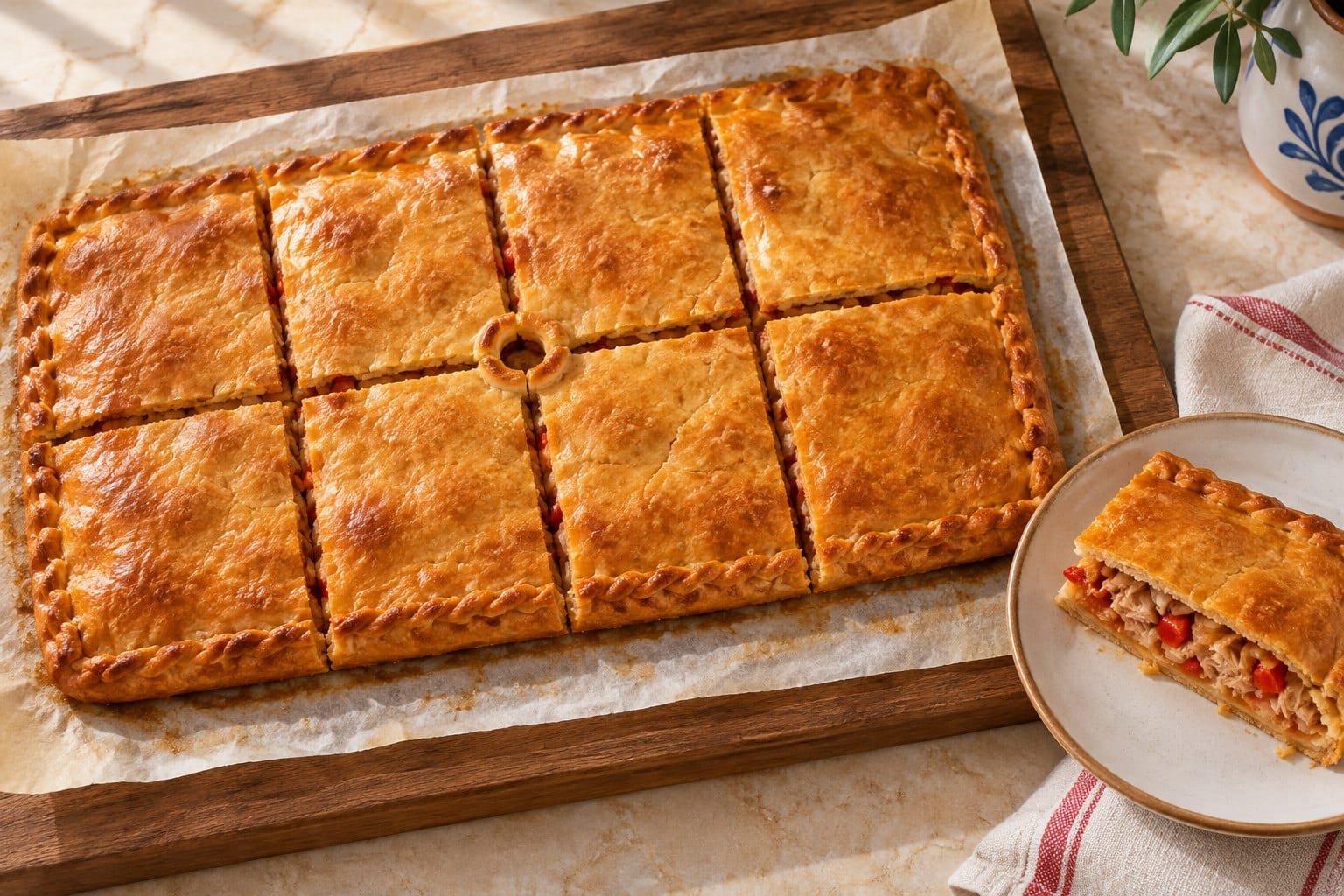
The important work happens before assembly: reduce the filling until it is moist but not watery, then let it cool. Hot, wet filling softens raw dough and makes a soggy base much more likely. There is no need for elaborate decoration; a well-sealed edge and a small steam vent do the useful jobs.
What to expect: One large rectangular empanada serving eight as a main dish with salad, or more as small tapas. The timing includes a yeast rise and a cooling period before slicing.
Jump to ingredients and method ↓
🥧 A Large Pie for Sharing
Galician empanadas come with many fillings, including tuna, meat and seafood. Spain’s tourism guide lists tuna with peppers as a popular empanada combination. This version uses pantry tuna and a wheat-flour dough, making the ingredients accessible without replacing the crust with puff pastry.
It is a useful addition to a Spanish sharing table alongside tortilla de patatas. The two can be served in small pieces, but a large slice of empanada is filling enough to be the main course.
⏱️ Time and Servings
| Stage | Time |
|---|---|
| Preparation | 40 minutes |
| Cooking | 70 minutes |
| Dough rising | 60 minutes |
| Cooling before slicing | 30 minutes |
| Total time | 200 minutes |
| Servings | 8 |
Allow about 3 hours 20 minutes as a generous planning window. Filling preparation and dough rising can overlap, so elapsed time may be shorter. A cool kitchen may require a longer rise.
🍲 Equipment You Will Need
- A large mixing bowl and clean work surface
- A rolling pin and a rimmed baking tray at least 35 × 30 cm
- Baking parchment and a pastry brush
- A wide pan, sieve and wire cooling rack
🛒 Ingredients for 8 Servings
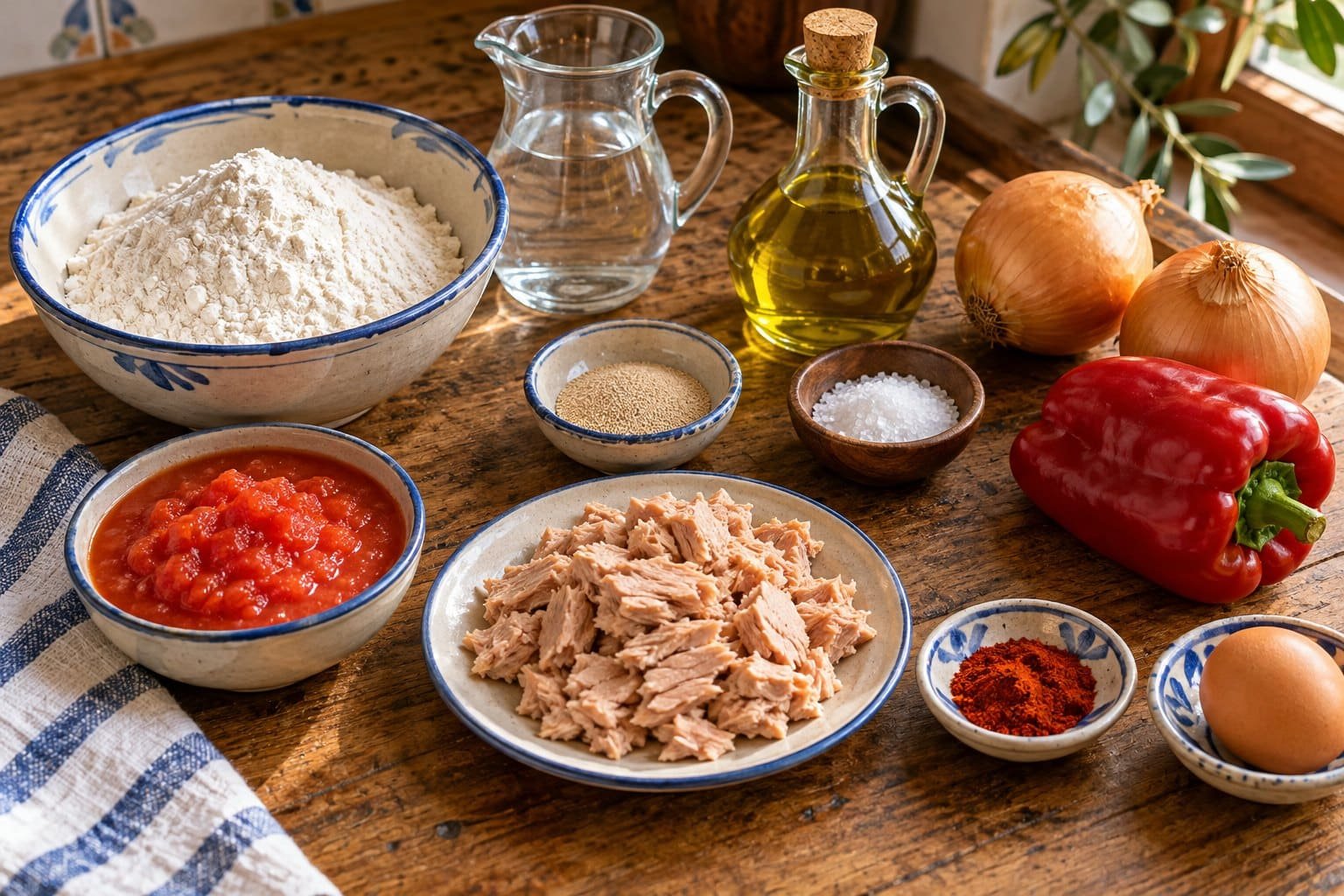
- 500 g all-purpose flour, plus a little for dusting
- 250 ml lukewarm water, not hot
- 100 ml olive oil for the dough
- 5 g instant yeast
- 7 g fine salt for the dough
- 500 g onions, thinly sliced
- 1 large red bell pepper, finely chopped
- 200 g canned crushed tomatoes
- 300 g canned tuna, weighed after draining
- 3 tablespoons (45 ml) olive oil for the filling
- 1 teaspoon sweet Spanish paprika
- ½ teaspoon fine salt for the filling, or less if the tuna is salty
- 1 egg, beaten, for glazing
Tuna: weigh it after draining. Both oil-packed and water-packed tuna work, but drain thoroughly and break into broad flakes rather than a paste. The stated olive oil for the filling is separate from the tuna’s packing oil.
Yeast: these instructions use instant yeast mixed into the flour. If using another type, follow its packet instructions for activation and quantities. Hot water can damage yeast; comfortably lukewarm water is enough.
Dough: ordinary all-purpose flour produces a manageable crust. Add extra dusting flour sparingly, because a heavily floured dough becomes stiff and difficult to seal.
Measurements: use a scale for flour, yeast and salt. Our baking measurement guide explains why cups do not convert identically for every ingredient.
👨🍳 How to Make Empanada Gallega
1️⃣ Cook the onion and pepper filling
Heat the 3 tablespoons filling oil in a wide pan. Add the onions, red pepper and filling salt. Cook over medium-low heat for about 20 minutes, stirring regularly, until very soft. Add the tomato and cook for another 10 minutes, until thick. Remove from the heat, stir in the paprika, then fold in the drained tuna.
2️⃣ Cool and check the filling
Spread the filling in a shallow dish to cool while you make the dough. It should be moist but have no pool of liquid at the bottom. If necessary, drain through a sieve without pressing it dry. Keep the cooling time short and refrigerate if assembly will be delayed; do not leave fish filling out for hours.
3️⃣ Mix and knead the dough
Mix the flour, instant yeast and 7 g dough salt in a large bowl. Add the lukewarm water and 100 ml olive oil. Mix to a rough dough, then knead for 8 to 10 minutes until smoother and flexible. If very sticky, rest it for 5 minutes before adding more flour.
4️⃣ Let the dough rise
Shape into a ball, put in the bowl and cover. Leave in a comfortably warm place for about 60 minutes, until visibly puffed and roughly doubled. A cool kitchen may take longer. Meanwhile, make sure the filling is no longer warm and line the baking tray with parchment.
5️⃣ Roll and fill the base
Heat the oven to 190°C / 375°F, or 170°C fan. Divide the dough into two pieces, with the base slightly larger. Roll the base to a thin rectangle about 35 × 30 cm, or to fit your tray, and move it onto the parchment. Spread the cool filling evenly, leaving a 2 cm border.
6️⃣ Seal and vent the pie
Roll the second piece to cover the filling. Brush the base border lightly with water, lay the top over and press the edges together firmly. Trim only very uneven excess, then fold and crimp the seam. Cut a small steam vent in the center and prick the top in a few places, avoiding the base.
7️⃣ Glaze and bake
Brush the top lightly with beaten egg without flooding the seam or vent. Bake for 35 to 40 minutes, until evenly golden and the underside is cooked and lightly colored. If the top browns too fast, cover loosely with foil and continue baking. Use a lower-middle oven shelf to help the base cook.
8️⃣ Cool before cutting
Transfer the empanada, still on its parchment, to a cooling rack when sturdy enough to move. Rest for at least 30 minutes before slicing. This lets steam escape and the filling settle. Cut into eight main-course portions or smaller squares and serve warm or cool, refrigerating any leftovers promptly.
🥄 How Dry Should the Filling Be?
Draw a spoon across the cooked onion mixture before adding tuna. The pan should show briefly, and watery tomato juice should not run into the gap. The filling must still be soft and juicy; the aim is to remove loose liquid, not fry the vegetables until leathery.
Spread it in an even layer rather than a mound. A thick central heap can keep the bottom crust damp and stretch the top until it tears. If the dough pulls back while rolling, let it rest for 5 to 10 minutes so it relaxes, then continue without forcing it.
🔄 Ingredient Swaps and Variations
- Other canned fish: drained canned mackerel gives a stronger flavor. Keep a similar drained weight and remove any bones you do not want in the filling.
- No red pepper: use green pepper for a less sweet filling, or add a little extra onion and reduce it thoroughly.
- Egg-free glaze: brush with a small amount of olive oil instead. The crust will be less glossy and may color differently.
- Shop-bought dough: a bread-style empanada dough can save time. Follow its baking guidance; puff pastry gives a different result and should not use the same timing blindly.
⚠️ Common Problems and Easy Fixes
- Soggy base: the filling was hot, wet or piled too thickly. Cool and drain it, and bake on a lower-middle shelf.
- The seam opens: flour or oil prevented a good seal. Moisten a clean border with water and press firmly before crimping.
- Tough dough: too much extra flour was added during kneading or rolling. Give the dough time to relax before adding more.
- The top cracks: it was stretched too tightly or had no steam vent. Roll it large enough and vent the center.
🍽️ What to Serve With It
Serve a main-course slice with a tomato salad or leafy greens. For a tapas spread, cut small squares and offer Padrón peppers alongside.
The pie travels better once cooled and sliced, but the tuna filling still needs appropriate chilling. For a picnic, pack portions in a cooler rather than treating the baked crust as a reason to leave fish at room temperature.
❄️ Storage and Reheating
Refrigerate leftover slices within 2 hours in a covered container and use within 2 days. Reheat in the oven until the filling is hot throughout; a microwave softens the crust. Keep any picnic portions chilled until serving.
Freeze cooled individual portions, well wrapped, for up to 2 months for quality. Thaw in the refrigerator and reheat thoroughly. Unbaked filled dough is less convenient to store because moisture continues moving from the filling into the crust.
🥄 Approximate Nutrition
| Per serving: one eighth of the empanada | Estimate |
|---|---|
| Calories | 480 kcal |
| Protein | 22 g |
| Carbohydrates | 60 g |
| Fat | 17 g |
| Fiber | 4 g |
Approximate amounts per eighth of the pie, using drained tuna and excluding side dishes. Tuna packed in oil can increase the estimate if not well drained.
❓ Frequently Asked Questions
Is this the same as a small empanadilla?
The filling idea is related, but this is one large baked pie that is sliced for serving. Small turnovers need their own dough handling and baking time.
Can I use tuna in water?
Yes. Drain it thoroughly and keep the measured olive oil in the filling. Oil-packed tuna also works once drained.
Does the filling need to be completely cold?
It should be at least cool rather than warm when it touches the dough. Chilled filling is fine if prepared ahead.
Why leave a hole in the top?
The vent lets steam escape instead of forcing the seam open or collecting under the top crust.
Can I make a round empanada?
Yes, if the dough remains thin and the filling layer even. Use a suitably large tray and check the base for doneness rather than relying on shape alone.
Recipe written for Spanish Grandma Recipes. By José María. The images are original AI-generated illustrations of the dish and ingredients.
Discover more from Spanish Grandma Recipes
Subscribe to get the latest posts sent to your email.