
📏 Cooking Measurement Conversion Chart: Cups, Grams, Tablespoons and Milliliters
Have you ever found a recipe you really wanted to make, only to stop when the ingredients suddenly switch between cups, grams, tablespoons and milliliters?
It happens all the time, especially when you cook recipes from different countries.
Many Spanish and European recipes use grams, milliliters and Celsius, while recipes from the United States often rely on cups, tablespoons, teaspoons and Fahrenheit.
This cooking measurement conversion chart is designed to make those differences much easier to understand.
You can use it to convert common kitchen measurements, check how much a cup of flour or sugar weighs, understand Spanish-style measurements such as a glass of milk, and quickly convert oven temperatures.
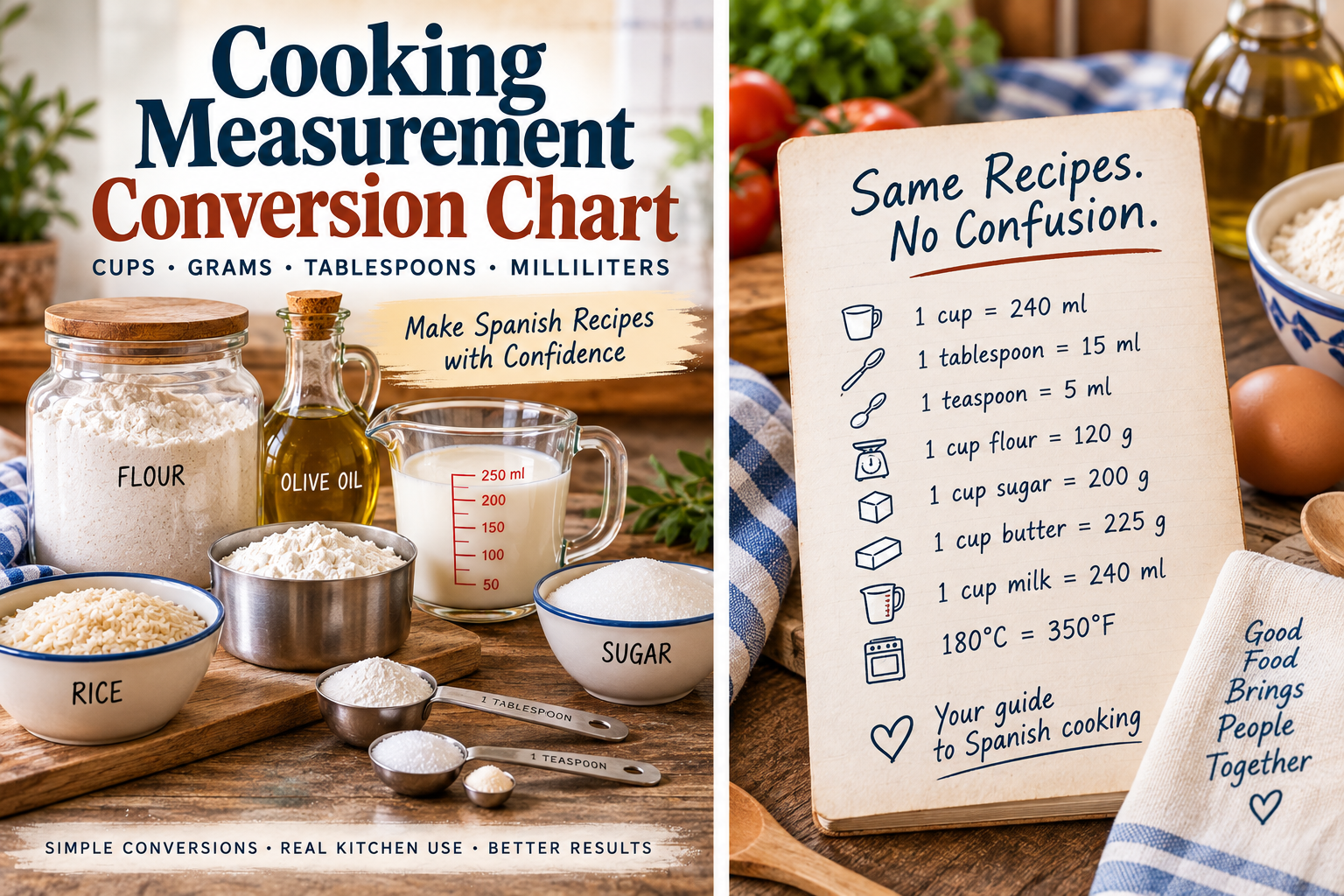
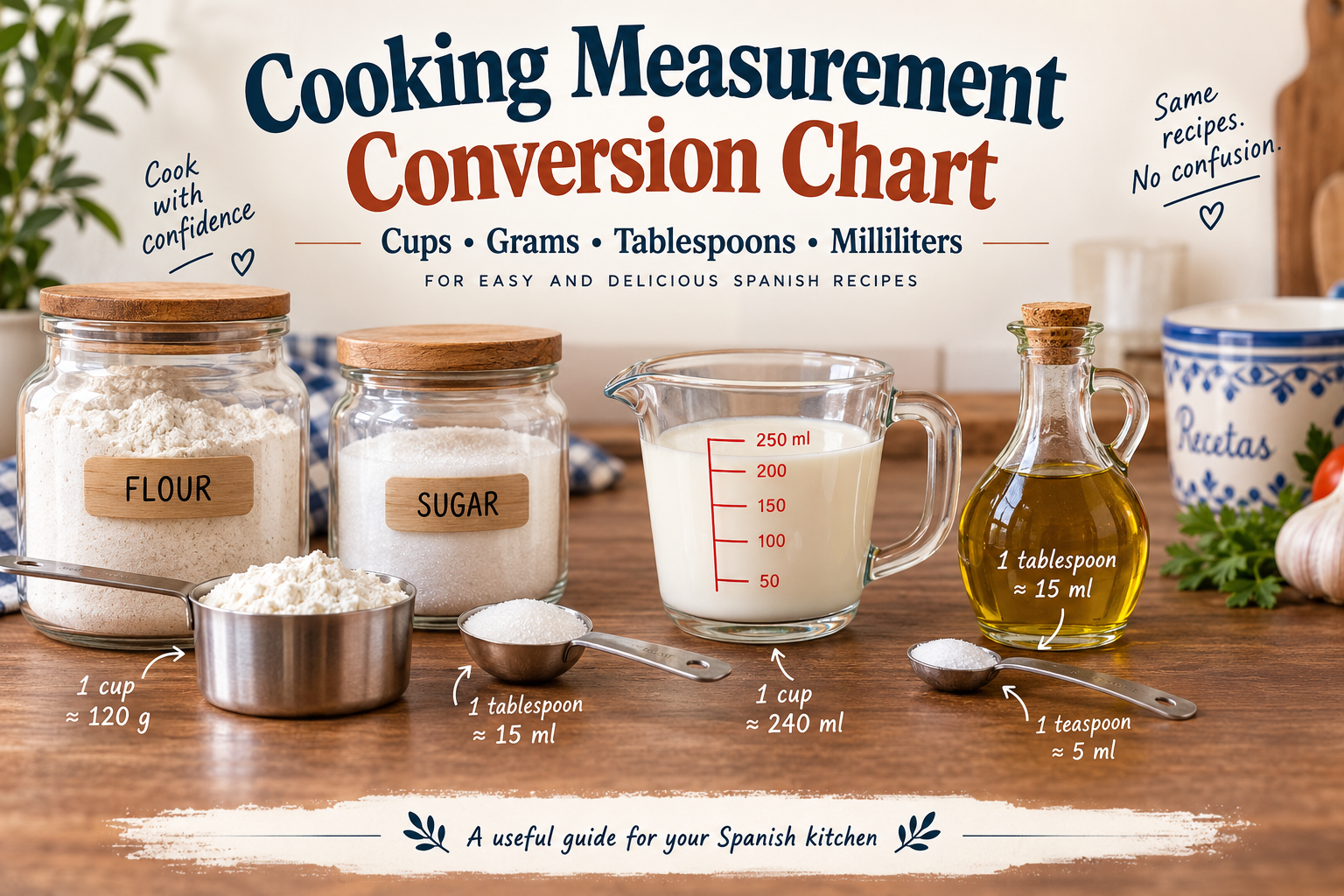
Quick answer: 1 tablespoon is approximately 15 ml, 1 teaspoon is 5 ml, and 1 standard US cup is approximately 240 ml. However, converting cups to grams depends on the ingredient because flour, sugar, rice and butter all have different densities.
🥄 Quick Cooking Measurement Conversion Chart
| Measurement | Approximate Equivalent |
|---|---|
| 1 teaspoon | 5 ml |
| 1 tablespoon | 15 ml |
| 1/4 cup | 60 ml |
| 1/2 cup | 120 ml |
| 1 cup | 240 ml |
| 2 cups | 480 ml |
| 4 cups | Approximately 1 liter |
| 1 liter | 1,000 ml |
These measurements work well as a general reference for liquids, but remember that cups cannot always be converted directly to grams. Weight changes depending on the ingredient.
⚖️ Cups to Grams Conversion by Ingredient
One of the most important things to remember when converting recipes is that one cup does not always weigh the same amount.
A cup measures volume. Grams measure weight.
A cup of flour is much lighter than a cup of sugar, even though both occupy the same amount of space.
| Ingredient | 1 Cup | 1/2 Cup |
|---|---|---|
| All-purpose flour | Approximately 120 g | 60 g |
| White sugar | Approximately 200 g | 100 g |
| Brown sugar | Approximately 180 g | 90 g |
| Uncooked rice | Approximately 200 g | 100 g |
| Breadcrumbs | Approximately 100 g | 50 g |
| Cocoa powder | Approximately 100 g | 50 g |
| Ground almonds | Approximately 100 g | 50 g |
| Butter | Approximately 225 g | 112 g |
| Milk | 240 ml ≈ 240 g | 120 ml ≈ 120 g |
| Olive oil | 240 ml ≈ 220 g | 120 ml ≈ 110 g |
These are useful home-cooking estimates rather than laboratory measurements.
For baking, bread and delicate desserts, a kitchen scale is still the most reliable option.
Precise measuring is especially useful when making desserts such as Spanish Arroz con Leche, where the balance between rice, milk and sugar affects the final texture.
🥄 How Many Grams Are in a Tablespoon?
This is another conversion that depends on the ingredient.
A tablespoon always measures roughly the same volume, but the weight changes depending on what you put in it.
| Ingredient | 1 Tablespoon | 1 Teaspoon |
|---|---|---|
| Flour | Approximately 10 g | 3 g |
| White sugar | Approximately 15 g | 5 g |
| Fine salt | Approximately 18 g | 6 g |
| Baking powder | Approximately 12 g | 4 g |
| Cocoa powder | Approximately 8 g | 3 g |
| Breadcrumbs | Approximately 8 g | 3 g |
| Olive oil | 15 ml | 5 ml |
| Vinegar | 15 ml | 5 ml |
| Honey | Approximately 20 g | 7 g |
| Melted butter | Approximately 15 g | 5 g |
For dry ingredients, assume these measurements refer to a level tablespoon, not a heaped one.
A heaped spoonful of flour or sugar can contain considerably more than a level spoonful.
🥛 Milliliters to Cups and Tablespoons
Liquids are much easier to convert because they are normally measured by volume.
| Milliliters | Approximate Kitchen Measurement |
|---|---|
| 5 ml | 1 teaspoon |
| 15 ml | 1 tablespoon |
| 30 ml | 2 tablespoons |
| 50 ml | 3 tablespoons + 1 teaspoon approximately |
| 60 ml | 1/4 cup |
| 120 ml | 1/2 cup |
| 180 ml | 3/4 cup |
| 240 ml | 1 cup |
| 500 ml | Approximately 2 cups |
| 1,000 ml | Approximately 4 1/4 cups |
🇪🇸 What Does “One Glass” Mean in a Spanish Recipe?
Traditional Spanish recipes sometimes use measurements such as one glass of milk, half a glass of olive oil or one glass of wine.
These are home-cooking measurements rather than exact standardized units.
As a practical guide:
| Spanish-Style Measurement | Approximate Capacity |
|---|---|
| Small glass | 150 ml |
| Regular water glass | 200 ml |
| Large glass | 250 ml |
| Yogurt container | About 125 ml |
| Half a regular glass | About 100 ml |
If an old Spanish family recipe simply says “one glass,” somewhere between 200 and 250 ml is usually a reasonable interpretation.
For stews, sauces and soups, a small difference rarely causes a problem because you can adjust the liquid while cooking.
For baking, it is better to use an exact measuring cup or kitchen scale.
🌡️ Celsius to Fahrenheit Oven Temperature Chart
Spanish recipes almost always give oven temperatures in degrees Celsius.
If your oven uses Fahrenheit, this quick chart will help.
| Celsius | Fahrenheit | Typical Use |
|---|---|---|
| 120°C | 250°F | Very slow cooking and drying |
| 150°C | 300°F | Slow baking |
| 160°C | 320°F | Gentle cakes and slow roasting |
| 180°C | 350°F | Cakes, casseroles and general baking |
| 190°C | 375°F | Roasting and baking |
| 200°C | 390°F | Vegetables, fish and roasted meats |
| 220°C | 425°F | Bread, pizza and strong roasting |
| 240°C | 465°F | Very hot baking and fast browning |
Every oven behaves slightly differently, so always look at visual signs as well as the temperature.
Color, texture and doneness are often more useful than following the clock blindly.
🍰 When Should You Use a Kitchen Scale?
For many savory Spanish recipes, exact measurements are not essential.
You can usually make small adjustments when cooking:
- Stews
- Soups
- Paella and rice dishes
- Sauces
- Roasted vegetables
- Chicken dishes
If a sauce is too thick, you can add more stock.
If a stew needs more liquid, you can add water.
If you want more garlic or paprika, you can adjust it to taste.
Baking is different.
For these recipes, using a scale is much more useful:
- Cakes
- Bread
- Pastries
- Churros dough
- Cookies
- Yeast dough
The proportion between flour, liquid, sugar and fat can completely change the texture.
👩🍳 How to Measure Ingredients Without a Kitchen Scale
1️⃣ Use the Same Cup Throughout the Recipe
If an old recipe uses one glass of milk, half a glass of olive oil and two glasses of flour, use the same glass for every ingredient.
Even if the glass is not exactly 240 ml, the proportions will remain consistent.
2️⃣ Level Dry Ingredients
When measuring flour, sugar, cocoa or baking powder, level the top with the back of a knife.
A heaped spoon or cup can contain much more than the recipe intended.
3️⃣ Do Not Pack Flour Into the Cup
Spoon flour gently into your measuring cup and level the surface.
Do not press it down.
Packed flour can make cakes, bread and dough much drier than expected.
4️⃣ Measure Liquids at Eye Level
Place the measuring jug on a flat surface.
Look directly at the measurement line rather than looking down from above.
5️⃣ Be Careful with Salt and Spices
It is usually better to start with less.
You can always add more salt, pepper, cumin or paprika later.
⚠️ Common Measurement Conversion Mistakes
Confusing Grams with Milliliters
Grams measure weight.
Milliliters measure volume.
For water, the numbers are almost identical because 100 ml of water weighs approximately 100 g.
That does not mean the same rule applies to flour, sugar, rice or olive oil.
Assuming Every Cup Holds the Same Amount
A standard US measuring cup holds approximately 240 ml.
A coffee cup, mug or breakfast cup may be much larger or smaller.
If a recipe needs accuracy, use a proper measuring cup.
Packing Flour Into the Cup
If you scoop directly into a flour bag and compress the flour, you may end up with considerably more than the recipe requires.
This is one of the most common reasons cakes and bread turn out dry.
Using the Same Cup-to-Gram Conversion for Every Ingredient
This simply does not work.
A cup of rice, sugar and flour occupy the same volume but weigh very different amounts.
Ignoring Level and Heaped Spoonfuls
Unless stated otherwise, conversion tables normally assume a level spoon.
A heaped tablespoon can contain much more.
🇪🇸 Measurements You Will Often See in Spanish Recipes
If you are cooking from a Spanish cookbook or family recipe, these are some of the measurements you are likely to see:
- g – grams
- kg – kilograms
- ml – milliliters
- l – liters
- cucharada – tablespoon
- cucharadita – teaspoon
- vaso – glass
- taza – cup
- pizca – pinch
- al gusto – to taste
You will also notice that Spanish recipes normally use Celsius rather than Fahrenheit.
This is especially useful to remember when cooking dishes such as Arroz al Horno, where oven temperature matters.
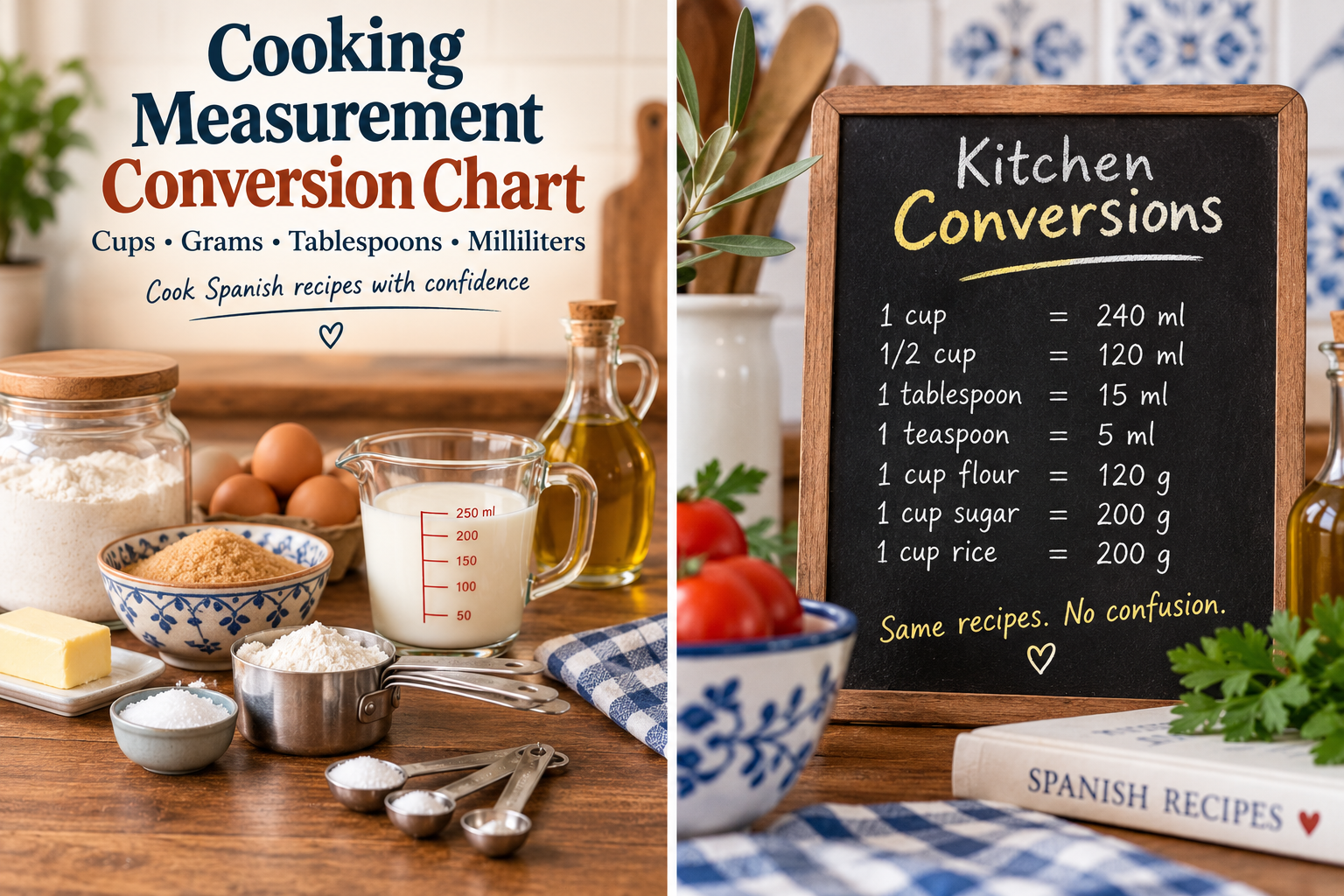
📌 Quick Kitchen Conversion Chart to Save
| Common Measurement | Quick Conversion |
|---|---|
| 1 teaspoon | 5 ml |
| 1 tablespoon | 15 ml |
| 4 tablespoons | 60 ml / 1/4 cup |
| 8 tablespoons | 120 ml / 1/2 cup |
| 1 cup | 240 ml |
| 1 liter | 1,000 ml |
| 1 cup flour | Approximately 120 g |
| 1 cup sugar | Approximately 200 g |
| 1 cup rice | Approximately 200 g |
| 180°C | 350°F |
| 200°C | 390°F |
| 220°C | 425°F |
❓ Frequently Asked Questions
How many milliliters are in one cup?
A standard US cup is approximately 240 ml.
Some metric recipes use a 250 ml cup, which is why very precise baking recipes are better measured in grams.
How many milliliters are in one tablespoon?
One standard tablespoon is approximately 15 ml.
How many milliliters are in one teaspoon?
One teaspoon is approximately 5 ml.
How many grams are in one cup of flour?
One cup of all-purpose flour is approximately 120 g when it is spooned into the cup and leveled without packing.
How many grams are in one cup of sugar?
One cup of white granulated sugar is approximately 200 g.
Is one cup always 240 grams?
No.
A cup measures volume, while grams measure weight.
One cup of water weighs around 240 g, but one cup of flour weighs much less.
How do I convert Celsius to Fahrenheit?
For a precise calculation, multiply the Celsius temperature by 9/5 and add 32.
For everyday cooking, it is usually easier to use a conversion table.
What does “a glass” mean in a Spanish recipe?
Traditional Spanish recipes may use a household glass as a rough measurement.
A normal water glass is usually somewhere around 200 to 250 ml.
Are cups or grams more accurate?
Grams are generally more accurate, especially for flour, butter, sugar and baking ingredients.
Cups and spoons are perfectly useful for everyday home cooking, but a kitchen scale gives more consistent results.
📚 A Useful Guide for Cooking Spanish Recipes
Switching between cups, grams, tablespoons and milliliters can seem confusing at first, but you quickly get used to it.
For everyday cooking, these conversions are more than enough to help you move between American and European recipes.
The important thing is to remember that liquids convert easily by volume, while dry ingredients need ingredient-specific conversions.
And when precision really matters, especially in baking, using a kitchen scale is still the easiest way to get consistent results.
Discover more from Spanish Grandma Recipes
Subscribe to get the latest posts sent to your email.